Equity Valuation of Yara International
Comprehensive financial analysis and equity valuation of Yara International ASA — covering accounting analysis, CAPM-based risk modelling, dividend discount valuation, and climate risk assessment.
Conducted as part of the BUS220 Finance course at NMBU. Yara International ASA was selected as the case company due to its global position within fertilizer production and sustainable agriculture. The objective was to evaluate whether Yara represented an attractive investment opportunity by combining financial statement analysis, valuation methods, market risk estimation, and climate-related financial considerations.

The Challenge
As financial analysts, we were tasked with preparing an investor-oriented report that could support investment decisions in the international equity market. The analysis required us to understand how Yara generates value, assess its financial health, evaluate market risk, estimate required returns, and determine whether the company's market valuation appeared reasonable.
Financial Statement Analysis
We performed a detailed analysis of Yara's balance sheet, income statement, and cash flow statements. The work included:
- Liquidity analysis
- Leverage and solvency analysis
- Profitability metrics
- Cash flow analysis
- Operational efficiency ratios
- Dividend policy assessment
This provided insight into Yara's financial strength, capital structure, and ability to generate shareholder value.
Market and Risk Analysis
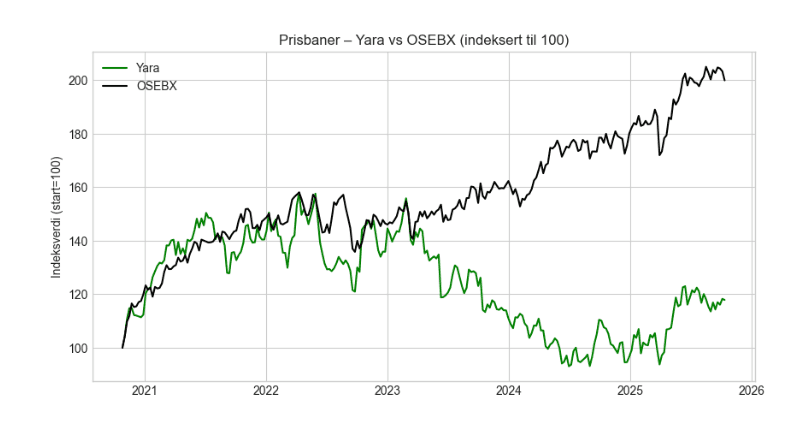
Historical stock data was collected and analyzed using Python, where statistical analyses, CAPM regressions, return calculations, and visualizations were implemented using Pandas, NumPy, and Matplotlib. Using five years of historical stock price data, we analyzed historical returns, volatility, dividend distributions, and market performance relative to the Oslo Stock Exchange Benchmark Index (OSEBX).

CAPM Beta Estimation
Capital Asset Pricing Model (CAPM) regression used to estimate Yara's market beta. The analysis measured how sensitive Yara's returns were to movements in the broader market, providing an estimate of systematic risk and cost of equity.
Valuation
Several valuation approaches were applied, including Dividend Discount Model (Gordon Growth Model), cost of equity estimation, Weighted Average Cost of Capital (WACC), and dividend sustainability analysis. The analysis was used to compare intrinsic value estimates with the market price of the stock and assess whether the company appeared fairly valued.
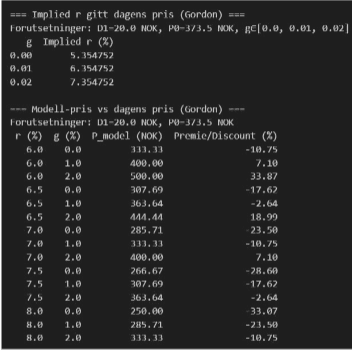
Dividend Discount Model (Gordon Growth Model) used to estimate the intrinsic value of Yara's stock based on expected future dividends, long-term growth assumptions, and the estimated cost of equity.
Key Findings
- Estimated market beta: 0.78
- CAPM regression statistically significant (p < 0.001)
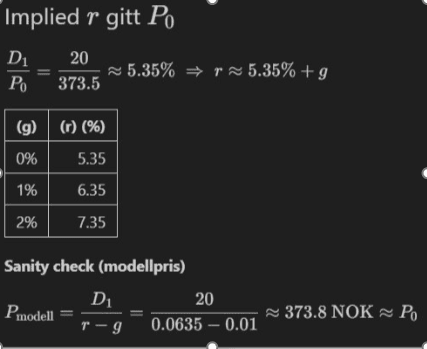
- Estimated fair value: ~374 NOK per share
- Market price at analysis date: ~374 NOK
- Yara appeared fairly valued under moderate growth assumptions
Climate Risk Assessment
As a global fertilizer producer, Yara faces significant climate-related risks and opportunities. The project examined physical climate risks, transition risks related to decarbonization, regulatory and policy risks, and green ammonia and sustainable agriculture initiatives. The analysis explored how these factors may influence Yara's long-term profitability and valuation.
What I Learned
This project strengthened my understanding of financial statement analysis, equity valuation, risk modelling, and capital markets. It also provided practical experience applying statistical methods and Python-based data analysis to real-world investment decisions.
Key Contributions
- Financial statement analysis across liquidity, leverage, profitability, and cash flow
- Beta estimation using CAPM regression on five years of historical market data
- Equity valuation using Dividend Discount Model and WACC
- Climate risk assessment covering physical, transition, and regulatory risks
- Investment recommendation based on intrinsic value vs. market price comparison